Saturday, September 8, 2018

Owner of Van Sweringens' Roundwood Manor sues Hunting Valley over denial of condo plan (photos)

81shares
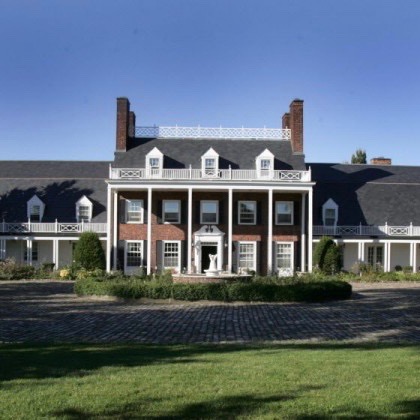
HUNTING VALLEY, Ohio - A lawsuit could determine the fate of historic Roundwood Manor, once the heart of the real estate and railroad empire built by the Van Sweringen brothers, builders of Shaker Heights and Cleveland's Terminal Tower.
Sylvia Korey, who has owned the 10-bedroom, 55,000-square-foot house since 1988, has tried unsuccessfully for 16 years to sell it, lowering the price from $7.9 million to $4.5 million.
Now she's suing the Village of Hunting Valley over its denial of her request to subdivide the big house into six luxury condominiums, which she believes would sell quickly to buyers who want to downsize from larger homes.
The village's zoning code requires a 5-acre minimum lot size for a single residence, a criterion Korey's proposal doesn't meet.
But Korey's lawsuit, filed May 2 in the Cuyahoga County Court of Common Pleas, asks the court to permit the subdivision and throw out the village's ruling.
She contends that the village's stand constitutes a taking of her property rights, and that the 5-acre acre minimum is unconstitutional because it serves no public purpose.
She also appealed to the court to review the village's administrative handling of her request, including requiring her to pay $20,000 in fees to have it consider a conditional use permit to allow the subdivision of the mansion, and later, in an amended request, to consider a special use permit.
"I've done everything I can to work with the Village to help them see the vision for Roundwood Manor," Korey said in an email. "I hate to have to resort to legal action, but it's the next logical step." 
Bruce Rinker, a lawyer representing Korey, said that historically, the 5-acre minimum zoning would have provided rural dwellings with enough room to separate septic systems from wells, a public health rationale that no longer applies to Hunting Valley.
Stephen Byron, the lawyer representing the village, said the 5-acre minimum lot size "is the heart of the village's zoning code."
He also said in an interview that "a property owner doesn't have a right to maximize the value of her property. She has the right to be able to sell and if she set a sale price at the right price, at what the market would pay, the house will sell."
Byron said that the village would respond to Korey's lawsuit and administrative appeal in a timely manner.
Korey's plight has attracted the attention of historic preservationists because Roundwood Manor is considered an icon of Cleveland's early 20th century expansion.
The lawsuit states that the only offer Korey received for her property would have paid only for the value of the land on which the house stands, and that the buyer would have torn it down.
"In my opinion, she's doing the community a favor because he's providing the opportunity for the house to be redeveloped," said Kathleen Crowther, executive director of the Cleveland Restoration Society.
Architect Philip Small designed Roundwood Manor for the Van Sweringens in the mid-1920s as their home and the nerve center of a business empire that collapsed in the Depression.
Subsequent Roundwood Manor owner Vernon Stouffer, president of the Stouffer Corp. and a former owner of the Indians, reduced the house by 35,000 square feet to its present size.
The house still includes a vast indoor swimming pool, several dining rooms, a soaring, two-story stair hall, a social hall known as the "Ship Room," and the "Dickens Room," where the Van Sweringens displayed books by the author.
After World War II, the 430-acre Daisy Hill farm surrounding Roundwood Manor became an exclusive suburban subdivision east of SOM Center Road and south of Shaker Boulevard, surrounded by a distinctive white plank fence.
The Daisy Hill Neighborhood Association, which governs the subdivision, opposes Korey's plans to divide the house into condominiums.
George Smerigan, the consulting planner for Hunting Valley, contends that installing condominiums in the house would increase traffic and noise, harming the owners of adjacent properties, according to a review of facts in Korey's lawsuit.
A native of Romania who grew up in Lakewood and who earned a bachelor's degree in civil engineering at Cleveland State University, Korey raised four daughters at Roundwood Manor with her husband, Samir Korey, from whom she is now divorced.
According to her lawsuit, Korey spent $1 million installing a new slate roof on the house. In interviews, she has said she pays $60,000 a year in property taxes.
All parties, including friends and sympathetic neighbors, say Korey has done an excellent job caring for her property, where she lives when she's not traveling.
Rinker estimated that Korey's administrative appeal could last 6 to 9 months before it is resolved, and that her lawsuit could take 9 to 12 months to reach a trial.
When asked whether Korey had the resources to pursue such a lengthy legal course, Rinker said: "She has wherewithal to see this through."

Comment:
  • 1 month ago
Why the he’ll don’t they do what Stan Hywet Hall and Gardens does? Give tours etc. if this place was to be torn down it would be a catastrophe! There is way to much history to let this place be lost forever! Wake the hell up and save the place!

Saturday, April 14, 2018

Request to convert historic mansion to condos denied


Chagrin Valley Times


Request to convert historic mansion to condos denied

    Ryan Dentscheff

HUNTING VALLEY — The Village Planning Commission denied a resident’s proposal Tuesday to convert the 55,000-square-foot Roundwood Manor mansion located in the Daisy Hill enclave into six condominiums.

Resident Sylvia Korey has been working on the proposal for about two years as a way to preserve the property. She attempted to sell the home for about 15 years, but the only interested buyers indicated they only wanted the property and would raze the house, which last year was added to the Ohio Historic Inventory.

She said the historic value of the home, originally built in the 1920s by Oris and Mantis Van Sweringen, is worth retaining. Converting it to the condominiums, and leaving the footprint and exterior of the building located on 7.69 acres at 3450 Roundwood Road, would be the best way to preserve the property. Keeping the large home as a single-family residence is no longer economically feasible, Ms. Korey has said.
On Tuesday, the commission voted 3-0 with one abstention to deny Ms. Korey’s request.
Planning Commission Chairman and village Council President Bruce Mavec said after a 30-minute executive session that the commission could not support the variance from the village residential zoning regulation that limits one residence per 5 acres of property.
The commission chairman only votes when there is a tie.
“The findings of the commission are that the density and zoning of 5 acres per residential unit is a key component of the zoning and therefore, we can’t grant the request,” Mr. Mavec said.
Jerry Medinger, who serves on the commission and village council, agreed.
“I think that the concept is one that I understand and under different sets of circumstances, I would support,” he said. “But I can’t see how what has been proposed doesn’t violate our 5-acre minimum zoning.”
Prior to a vote, Ms. Korey’s attorney, Bruce Rinker, made several comments pertaining to the case as to why the authority is in the hands of the commission – a point that had been debated in previous meetings – and why the proposal is unique and necessary for this historic property.
Commission member Christopher Nook, who also voted to deny the request, said he doesn’t want to see the home demolished.
“I want to make sure it’s clear that I’m not suggesting or in support of demolishing the home,” Mr. Nook said. “I’d like to see another resolution to restore it or keep it intact, but I don’t think this is the right one.”
While some members of the commission may believe that there are other options to preserve the home, Mr. Rinker and Cleveland Restoration Society Executive Director and President Kathleen Crowther said after the meeting that the proposed conversion is the best and only solution.
Ms. Crowther was involved in the process as a historic homes expert.
“We’re very disappointed and think that the decision by the commission is short sighted,” Ms. Crowther said. “(The decision) doesn’t promote preservation, it encourages demolition.”
Mr. Rinker said that allowing the conversion to condos would have stood the test of time. Now, he said, the decision could be seen by outsiders as “a black eye” for Hunting Valley.
“It’s a pretty extreme position to take in the face of all the evidence and good reasons that support preservation that Ms. Korey has promoted here,” he said. “We’ve had the Cleveland Restoration Society look at it, a lot of friends and neighbors, and there are a lot of people who have indicated that not only do they think it would work, but they would love to live there. That’s a win-win when you can preserve the history.”
Because a special-use permit was requested by Ms. Korey, village code does not call for an appeals process to council. Instead, she would have to take the matter to the Cuyahoga County Common Pleas Court within 30 days of the commission’s decision.
“In the past, I was hopeful that going to court would be the last option,” Ms. Korey said, indicating that she had not made a decision as of yet on the next step.
In response to being asked to elaborate further on the possibility of an appeal to the court, Mr. Rinker said, “For you to make it work, that’s the last option.”

Saturday, April 7, 2018

Condo proposal for historic mansion likely to be denied

Condo proposal for historic mansion likely to be denied

Print
Font Size:
Default font size
Larger font size
Posted: Thursday, March 15, 2018 12:00 am
HUNTING VALLEY — The village Planning Commission is poised to deny an application to convert the historic Roundwood Manor, a 55,000-square-foot residence within the Daisy Hill enclave, into six condominiums.
After nearly two hours of discussion on Tuesday morning, commission members said they likely would not support a variance of the village’s longstanding zoning requirement of one residence per 5 acres of land. The three members in attendance voted unanimously to have Law Director Stephen Byron draft conclusions of fact that would support denying the application.
Sylvia Korey, the owner of the manor and 7.69-acre property, several years ago proposed the idea of transforming the interior of her house into six individual condos to be sold as separate residential units. She has attempted to sell the home since 2002 and said the only interest she received was a prospective buyer who wanted to raze the mansion and build a new house on the land.
She said she came up with the condominium idea because the property has become too expensive to maintain and converting it would be an economically viable way to preserve its historic value. The home originally was built in the 1920s by Oris and Mantis Van Sweringen and last year was added to the Ohio Historic Inventory as a historic property in the state.
Ms. Korey’s team of attorneys, historic property experts and planning consultants have presented their case to the planning commission over the past several months as to why converting the property is feasible and appropriate. The village has also heard from people in opposition of the project including the attorney representing the Daisy Hill Homeowners Association, Sheldon Berns. Also speaking against the plan was George Smerigan, the village planning consultant who presented his report Tuesday.
Various topics were discussed Tuesday, with the most notable being how and if converting the property would be a detriment to neighboring property values.
Mr. Smerigan and Ms. Korey’s team, primarily attorney Anthony Coyne, butted heads during the meeting this week on how the transformation would impact the community.
Mr. Coyne argued that under the current zoning code, the planning commission has the discretion with a special use permit application – which is what is being requested – to allow any use within the U-1 residential district that does not create “substantial injury” to neighboring properties.
“It’s not changing the footprint of the structure,” he said. “The visual effect on the community is not going to change and frankly, the likely number of residents will be less than (the number) who have continually occupied the house over most of its existence.”
Ms. Korey said during the 30 years when she lived with her growing family, as many as 14 people occupied the house at one time.
“I have not heard any substantial injury to the adjacent properties, that you have any objective or subjective evidence to present to the commission,” Mr. Coyne said, directing his comment to Mr. Smerigan. “To let this property fall into disrepair, to sell it to somebody who wants to demolish it I think would be most unfortunate and I think it would be a real black eye to Hunting Valley if you let that happen.”
Mr. Smerigan said the key issue is in changing the density requirement.
“In my professional opinion, it’s not consistent or compatible with the single-family residential standard and the density standard,” he said. “In my opinion, it would have a detrimental impact on the values of the adjacent properties.”
He said to the commission that in allowing the increased density on the property “you’re essentially going to change the nature and character of the village. And I think you’re going to do it in a way that is going to adversely impact a fairly significant number of the property owners in the village.”
After each side was finished presenting their stance, the three commission members in attendance – Chris Nook, Councilman Jerry Medinger and Council President Bruce Mavec – adjourned to a brief executive session to discuss imminent litigation with counsel. After reconvening, all three members said they could not agree with increasing the zoning density.
“I’m very much in favor of historic preservation and I think it’s always an excellent thing to pursue,” Mr. Mavec said. “My only road block is the 5-acre density, which has been a sacrosanct part of the zoning code and I have yet to be convinced how that wouldn’t undermine or blow a hole in that by agreeing to do this under this current request.”
Mr. Medinger said, “I agree 100 percent with the concept of trying to foster preservation. But I’ve never been able to get myself comfortable trying to understand, if we were to accept this proposal, how it couldn’t negatively impact the 5-acre zoning. Until I’m convinced that’s not the case, I just can’t support the proposal as it’s been presented.”
The commission is expected to vote on the proposal at its April 10 meeting. There are six commission members and three votes are needed for approval. If her application is denied, Ms. Korey could appeal to the Cuyahoga County Common Pleas Court.

Friday, May 13, 2016

"Fortunes & Misfortunes": The Estates of Hunting Valley

On Saturday, April 23 and Sunday, April 24, two sold out crowds of over 250 people gathered in the Ship Room at Roundwood Manor to hear Dan Ruminski, Cleveland's Storyteller, share the history of the Van Sweringen brothers, their move to Hunting Valley and the tale of historic Roundwood Manor around which the Daisy Hill subdivision was built. After Dan's fascinating and informative lecture, tours of the home were given. This was a wonderfully successful event for those attending as demand for tickets far exceeded availability. Proceeds benefited the Hunting Valley and Gates Mills Historical Societies and the Cleveland Restoration Society.
 

"Commentary: Downsizing fits city, not village"

     If it were up to Charles Dickens, this could be a tale of two well-to-do cities, except that one is a village. The city, Pepper Pike, population 6,149 and median household income $143,438, is one of the wealthiest communities in Ohio. Its next-door neighbor, the village of Hunting Valley, population 713 and median household income $250,000-plus, is one of the most affluent places to live in the United States.     

     Pepper Pike is on the verge of welcoming two townhouse developments that would revitalize an older neighborhood on the northern edge of the city near the border of Mayfield Heights. Hunting Valley doesn't appear to be ready for a quite different multifamily housing proposal that could preserve while renewing one of the area's most notable historic estates.     

     Enabled by the foresighted establishment of a townhouse district along Cedar Road in 2003, developer Jason Friedman has proposed a 40-unit complex of duplexes on eight acres just east of Brainard Road. He envisions homes ranging in size from 1,900 to 2,500 square feet and in price from $350,000 to $500,000. This proposal follows one led by the Orlean Co. that would feature 42 condominiums about a half mile farther east.     

     Mayor Richard Bain expressed support for both projects, saying they are evidence that "Pepper Pike remains a premiere location for high-end home construction."     

     Speaking of high-end housing, though, few can compare to the 55,000-square-foot Roundwood Manor mansion that has been on the market since 2002 in Hunting Valley's prestigious Daisy Hills subdivision. Situated on about 7.7 acres, the mansion was even larger at 90,000 square feet when it was transformed in 1928 from a barn by the famed Van Sweringen brothers.     

     Owner Sylvia Korey, who has lowered the asking price from $7.5 million to $4.5 million but still sees little prospect of finding a single buyer for the iconic home, is advancing a new concept of converting it into seven condominium units. There is some precedent for such solutions that have preserved other historic estates. Hunting Valley Councilman William J. O'Neill Jr. believes it would be a good fit for the village.     

     But it would need approval from the Daisy Hill Homeowners Association, and its five-member board of trustees unanimously rejected it.     

     Mr. O'Neill expressed concern that aging Hunting Valley residents do not have a place to downsize within the village that has long been their home and said Ms. Korey's proposal "is really a perfect solution."
     
     The new townhouses and condos in Pepper Pike "will provide a great alternative" for such residents who wish to remain in their community, Mayor Bain said.  
   
     But what's "a great alternative" in Pepper Pike isn't necessarily "a perfect solution" in Hunting Valley. After all, they are two different communities.

Chagrin Valley Today, 21 April 2016

"Elegance of yesteryear: Owner searching for ways to preserve Van Sweringen abode in tranquil Daisy Hill"


By Ryan Dentscheff

HUNTING VALLEY — Rich with history dating back to the early 1900s, Roundwood Manor remains largely unscathed after nearly a century atop the highest peak of the Daisy Hill subdivision.
The now 55,000-square-foot mansion on 7.69 acres of land was transformed in 1928 from a barn into a 90,000-square-foot estate by notable architects Oris Paxton and Mantis James Van Sweringen who made their home there.
They designed countless houses and are best known for building the Terminal Tower in Cleveland and developing the city of Shaker Heights. While Roundwood Manor was reduced in size in the 1950s, much of the iconic Van Sweringen brothers’ architecture remains intact.
But a house that size is expensive to maintain. Annual taxes alone, according to county records, add up to nearly $60,000.
The home features a three-story sky lighted central hall, 14 bedrooms, more than a dozen bathrooms, nine fireplaces, a tennis court, indoor swimming pool, sauna and steam room.
Owner Sylvia Korey lives alone in the house now that her four daughters are grown up.
She has been trying to sell the mansion since 2002.
With no buyers in sight, she also has been trying to find new life for the historic house by proposing to convert it into spacious condominiums, an idea that has so far been rebuffed.    
“It’s heritage. It’s legacy. It’s history,” Ms. Korey said. “This house is an icon. It is the history of the Van Sweringens and they are the history of Cleveland.”
Ms. Korey purchased the house in 1989 for $1.025 million and has since restored much if it back to its original grandeur, including removing cement and carpet that covered original slate floors on the ground level. She also refinished one section of the property once used just for storage and installed a new slate roof.
The original mosaic-tiled indoor pool room – which features a 60-by-25 foot swimming pool – Dickens Library, living room, wood-burning fireplace and hardwood beams, floors and banisters throughout the home retain their original elegance. The ceiling beams in the “ship room” still contain the metal rings where farmers hung and butchered meat when that area was used as a barn in the 1910s and 1920s.
In an effort to sell the property, Ms. Korey has used numerous Realtors and reduced the asking price from $7.5 million to $4.5 million.
Paramount to her is preserving the house. A few residents, she said, want to see it torn down so the land can be used for new construction. But she said she will hold onto the property for as long as it takes to find a buyer dedicated to leaving the house standing.   
“We have to act responsibly and can’t just discard it like yesterday’s lunch,” she said. “We need our old buildings to maintain a sense of permanency and heritage for ourselves and for the future generations.” 
Her idea to convert the mansion to condos is a preservation strategy catching on across the U.S. A retired civil engineer, Ms. Korey drafted plans for converting Roundwood Manor into seven condos, each about 2,500 square feet. She presented the idea to the Daisy Hill Homeowners Association Board of Trustees, but the five-member group denied the request, she said.
None of the Daisy Hill trustees responded to the Times’ requests for comment. Ms. Korey said members did state that they don’t want multi-family units within what is now a single-family subdivision. Daisy Hill is home to about 60 large homes. 
“I’ve heard that some people may see this house as a relic of a bygone time that no longer serves a purpose. So I say, ‘people, let’s use our heads and repurpose it.’ I don’t want to see it torn down.”
Historian Daniel Ruminski, known as  Cleveland’s Storyteller, agreed that the condominium idea is a good one. He hosts talks on the area’s history and historic homes throughout Northeast Ohio.
Mr. Ruminski is scheduled to give a walking tour and talk at 2 p.m. April 23-24 at Roundwood Manor. Admission is $20 and about 100 guests are expected on both days. A limited number of tickets still are available with proceeds going to the Hunting Valley and Gates Mills historical societies as well as the Cleveland Restoration Society.
“To get into Roundwood Manor for people to see the extraordinary craftsmanship and size of it is what we’re really excited about,” Mr. Ruminski said. “People are going to be able to feel and touch Cleveland’s gilded age.”
The condo idea, which would allow the exterior and interior of the property to remain intact, is a great solution for preserving historic estates, he said. It has been done in other locations in Northeast Ohio, he said, including some mansions in Shaker Heights. Historic estates formerly owned by prominent Clevelanders Walter White and Francis Drury have remained intact in their new role as schools on the campuses of Hawken and Gilmour Academy, respectively, he said.
“I think her goal, of all the things she could do, the condominium idea is the best,” Mr. Ruminski said. “To preserve these mansions, this is something that you have to do.”
Some Daisy Hill residents support the condo idea, Ms. Korey said.
One outspoken supporter is Village Councilman Bill O’Neill who said condos on that  property would be a good fit for Hunting Valley, providing an alternative housing option. 
“For a long time, I have been concerned that Hunting Valley did not have a place for its residents who want to downsize as they get older,” Mr. O’Neill said. “I believe many of those people would like to live in Hunting Valley, they have strong attachments to it, but there’s not a suitable place that (the village) can offer to them.
“I think that converting Roundwood Manor into condominiums as Sylvia proposes, is really a perfect solution.”
He doesn’t think condos would disrupt or change  the current quality of life in the community and neighbors likely wouldn’t notice a difference.
Mr. O’Neill, who now resides about a half-mile from Roundwood Manor, lived in Daisy Hill for more than 40 years. He recalled playing football on the property as a kid and referred to property as an “asset to the community.
“I think it’s important for the community to preserve Roundwood Manor,” he said. “It’s a very important structure in Northeast Ohio and certainly in our community and to have it torn down I think would leave a great hole in the future.”
Mr. O’Neill said council has not formally discussed the idea and the Daisy Hill Association would need to approve the concept first.
“My hope would be that the Daisy Hill Association would open up a conversation with Sylvia so they can understand exactly what she’s proposing, and if they have any reasons to object any of it, bring those reasons up and let them be talked out,” he said. “I’m quite confident that any reason they may have against it could be satisfied with dialog. If that could be done, I think you could have the pathway to a solution.”
Philip Botta
Philip Botta
Philip Botta